

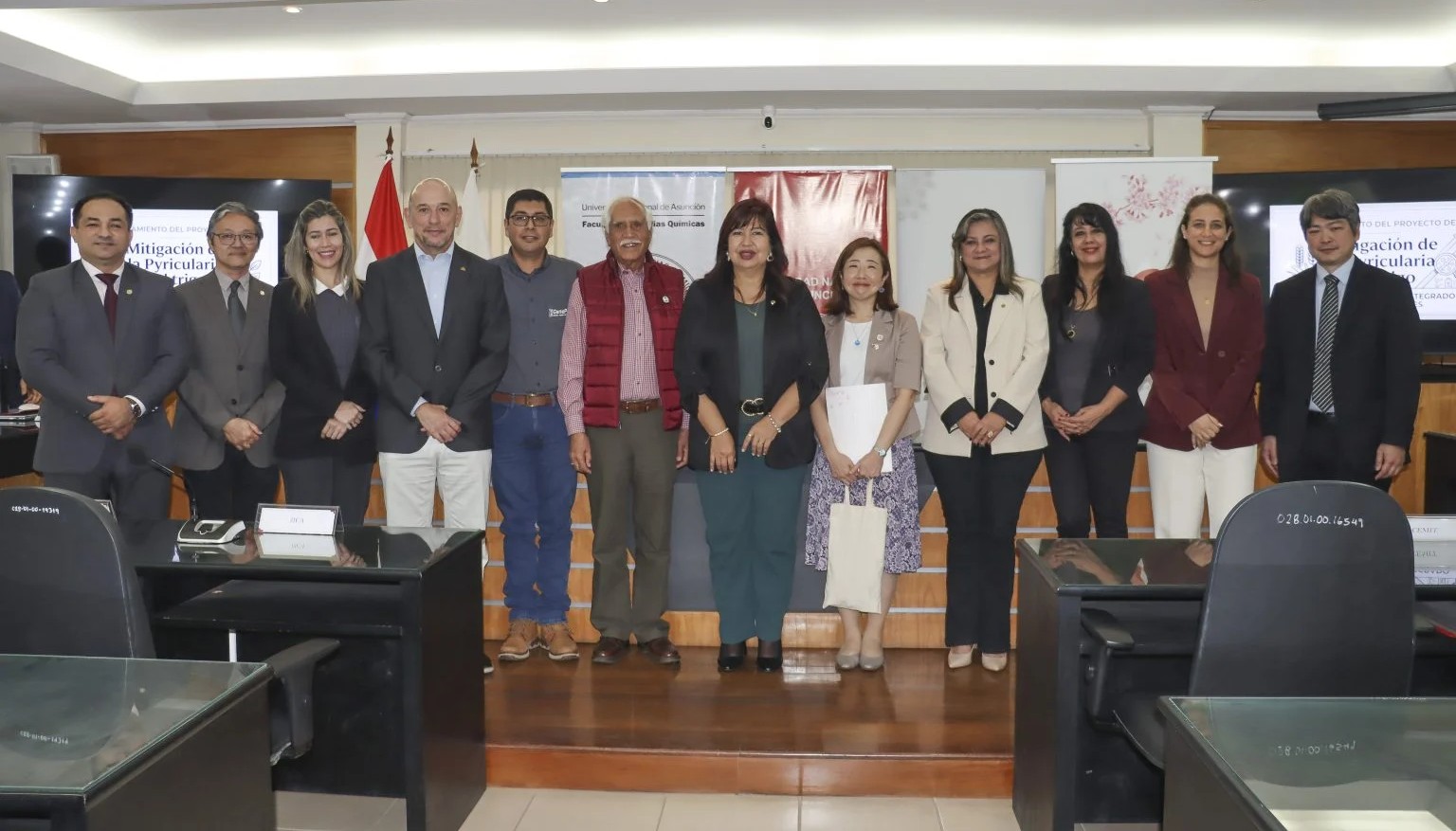
Asunción, Agencia IP.- The National University of Asunción (UNA) launched the first Partnership for Scientific and Technological Research for Sustainable Development (SATREPS) project in Paraguay, an international initiative seeking to develop innovative solutions to combat wheat blast (Pyricularia), a disease capable of causing losses of up to 100% of wheat production. It will receive USD 1,850,000 in funding from the Government of Japan for joint research between Paraguayan and Japanese specialists.
The initiative is part of the SATREPS program, promoted by the Government of Japan with support from the Japan International Cooperation Agency (JICA).
The project brings together the Faculty of Chemical Sciences and the Paraguayan Chamber of Exporters and Traders of Cereals and Oilseeds (CAPECO) as the main counterparts in Paraguay, along with Kobe University as the Japanese strategic partner.
For the first time, Paraguay has accessed this prestigious international scientific cooperation mechanism, considered one of the most important in the world for its ability to link academic excellence with concrete solutions to development challenges.
Also participating are the Multidisciplinary Center for Technological Research (CEMIT-UNA), the company GenePar, and Kyoto University, strengthening a high-level scientific cooperation network.
Challenge for the economy and food security
Wheat blast, caused by the fungus Pyricularia oryzae, represents a growing threat to national agricultural production. Under favorable climatic conditions, the disease can destroy between 60 and 100% of the yield of affected crops within weeks, jeopardizing producers’ profitability and the stability of a strategic production chain for the country.
During the 2025 agricultural season, approximately 350,000 hectares of wheat were planted in Paraguay, yielding an estimated 1.2 million tons.
The crop is one of the main winter crops and a significant source of income for thousands of rural families, in addition to providing raw materials for the domestic market and for export.
Professor Cynthia Saucedo, Dean of the Faculty of Chemical Sciences at the National University of Asunción (UNA) and the project’s director, emphasized that the initiative represents much more than scientific research. It is a strategic alliance between academia, the productive sector, and international cooperation. «Our goal is to transform knowledge into real solutions for Paraguayan agriculture and strengthen the country’s capacity to respond to a threat that transcends borders,» she stated.
The professor also highlighted that rice blast (Pyricularia pyricularia) has already caused severe epidemics in Paraguay, particularly in 2002 and 2023, with losses exceeding 70% on numerous productive plots.
The project manager, Professor Julio César Iehisa, explained that the research will leverage scientific advances developed by specialists at Kobe University, who identified genes with the potential to confer resistance to the fungus.
From regional problem to global threat
The disease was first identified in wheat in Brazil during the 1980s and subsequently spread throughout South America.
In recent years, outbreaks have also been recorded in Asia and Africa, particularly in Bangladesh and Zambia, raising concerns for global wheat production.
Project to be initially implemented in Alto Paraná and Itapúa
The project will last five years, from August 2026 to August 2031. Initially, it will be implemented in the departments of Alto Paraná and Itapúa, the country’s main wheat-producing areas, with plans to expand to other agricultural regions.
In addition to generating cutting-edge scientific knowledge, the proposal includes developing an Integrated Disease Management Manual to transfer research results to producers and technicians in the sector.
With this initiative, Paraguay strengthens its position in international agricultural research and reaffirms the UNA’s role as a leading institution in generating knowledge oriented towards sustainable development, technological innovation, and the competitiveness of the national productive sector.